Product 05 / Mecate

Mecate.

A 1970s Italian string machine, recreated through analog circuit modelling: every stage built from the service manual's schematics and calibrated against a real unit. Strings, brass, piano, clavichord and bass on a split keyboard. AU, VST3 and Standalone for macOS, Windows and Linux; Standalone and AUv3 on iPad.

SHIPPINGv1.0.2€4.99 · macOS / Windows / iPad · Linux free
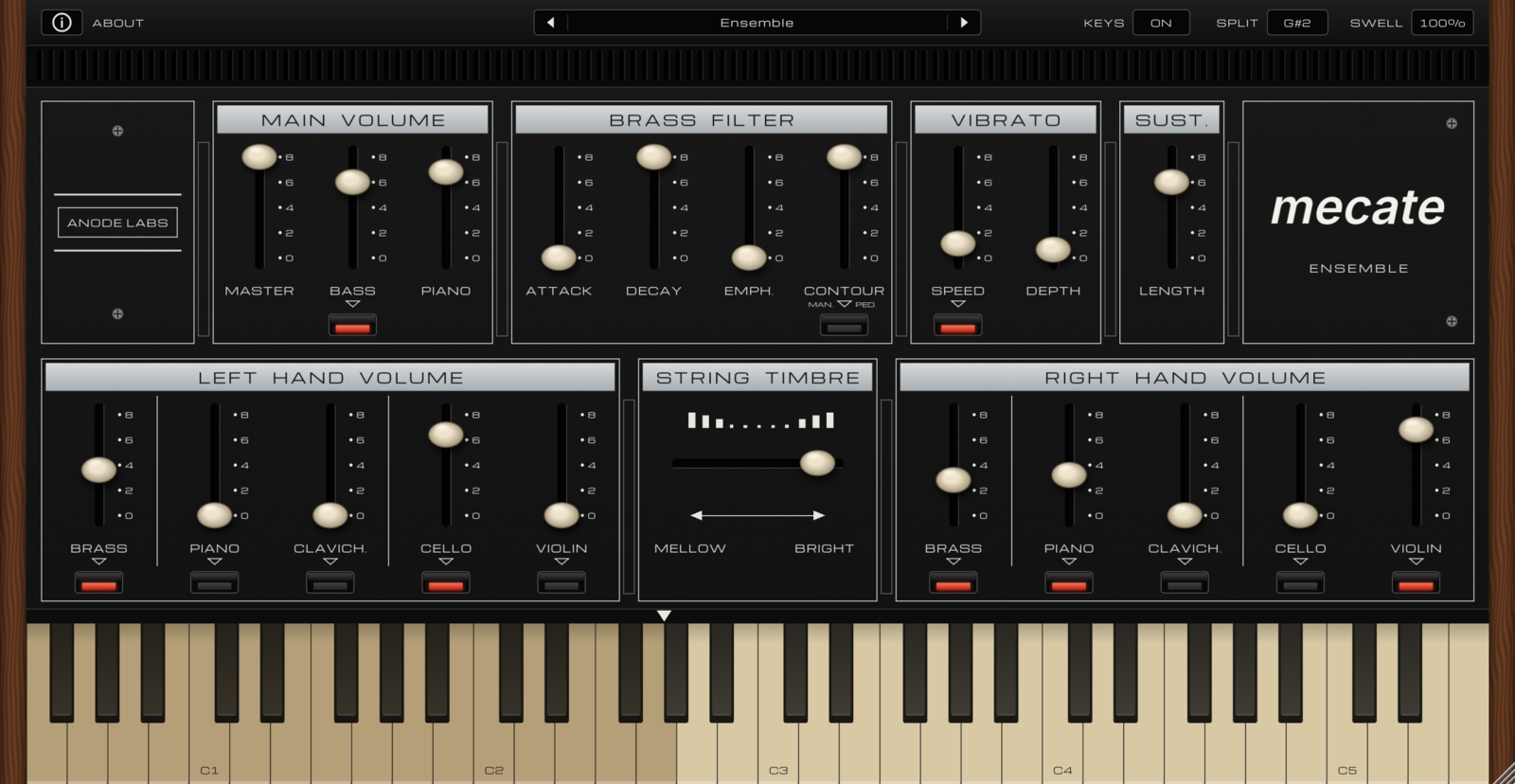
Mecate: a dark panel with main volume, brass filter, vibrato and sustain sections, per-hand voice faders and string timbre, above a 61-key keyboard with a split marker
00 · Demo

No talking, just playing.

One take per factory preset; the captions name the control that moves. Sound and picture come from the plugin itself. The music is J. S. Bach, Scott Joplin and two progressions of our own. Also on YouTube, with chapters.

01 · The instrument

Analog circuit modelling, one stage at a time.

A 1970s Italian string machine: cello, violin, brass, piano and clavichord over a split keyboard, and a bass on the bottom keys. Mecate models its analog circuits stage by stage from the service manual's schematics: the key cells simulated at component level, the brass filter as a transistor ladder, the ensemble as bucket-brigade lines. Every stage was then calibrated against recordings of a real unit.

The panel is the hardware's panel, so the controls you reach for are the ones that were there. The free Mecate for Decent Sampler is a sample library: it plays recordings of the same machine. This is the machine itself, modelled.

02 · At a glance
Model
ANALOG CIRCUIT MODEL
Voices
6
Polyphony
FULL
Keys
61, SPLIT
Presets
8 + YOURS
Outputs
MAIN + 6
Formats
AU / VST3 / LV2 / AUV3
Price
€4.99 / LINUX FREE
03 · The panel

Modelled, not sampled

Analog circuit modelling from the top-octave generator and divider chain to the voice filters and the ensemble. Each stage follows the service manual's schematics and is calibrated against recordings of a real unit, so the tone comes from the circuit, not from a set of samples.

Every key has a circuit

As on the hardware, each key has its own cell, simulated at component level in SPICE, transistors and diodes included. Every key you hold sounds, with no voice count and no stealing, and a cell responds to its envelope the way the transistors do, not in a straight line.

Split hands, a volume per voice

Brass, piano, clavichord, cello and violin each get a fader and a tab per hand. The bass sits on the bottom keys with a tab of its own. Move the split wherever you like.

A transistor ladder for the brass

The brass filter is the board's four-pole transistor ladder, modelled with zero-delay feedback and the transistors' saturation, and oversampled so it stays open and stable at any setting. Every brass note opens its own filter. Attack and Decay shape the sweep, Emph. adds resonance, Contour sets where it comes to rest. Man./Ped. hands the sweep to a foot controller on CC 4.

A bucket-brigade ensemble

The ensemble's chorus runs through emulated bucket-brigade delay lines, 185 stages each, clocked like the chips themselves. The charge each transfer leaves behind, the hold and the reconstruction filter are all there, so the movement and the slight grit of the original come with it.

Swell, vibrato, timbre

A swell pedal on CC 11, a sustain pedal on CC 64, vibrato speed and depth on the strings, sustain length, and String Timbre from mellow to bright.

Your presets, as files

Save, rename and delete your own presets next to the eight factory ones. Import and export them as files to move them between machines, iPad included.

Separate outputs

Each voice on its own output as well as the stereo mix, for hosts that take multi-output instruments.

Keyboard on or off

KEYS hides the on-screen keyboard when you play from a controller, and the window shrinks to the panel.
04 · Presets

Eight starting points, then yours.

Every preset loads the whole panel. Change anything and save it as your own; export it as a file to take it to another machine.

Ensemble

Cello and brass on the left, violin on the right. The whole machine at once.

Strings

Cello and violin, slow attack, gentle vibrato.

Brass

Brass on both hands, with the filter envelope doing the talking.

Piano and Strings

Piano on top, strings swelling in behind.

Keys

Piano and clavichord, blended per hand.

Clav

Clavichord: bright, percussive, short release.

Slow Pad

Slow attack, long release. Leave the room.

Bass

Bass. It is a bass.

05 · System requirements

What it runs on.

macOS
macOS 12 or later, Apple silicon or Intel.
iPad
iPadOS 17 or later.
Windows
Windows 10 or 11, x64.
Linux
x64 or arm64.
06 · Questions

Is it the same instrument as the free Decent Sampler library?

Same machine, different approach. The library plays recordings of the real unit; mecate models its analog circuits, so every key, filter and ensemble line is computed as you play and responds to the panel the way the hardware does.

Do I need a license key or an account?

No. It is DRM-free: download, install, play. Updates free forever.

Why does my VST3 host only list the factory presets?

VST3 fixes a plugin's preset list when it loads, so the host lists the eight factory presets. Your own presets are in mecate's preset menu, in every host.

Logic doesn't name the track after the preset when I add mecate.

Logic only renames the track when you change preset after inserting the plugin. Pick any preset and the track follows.

Can I move my presets to the iPad?

Yes. Export them as files on the computer, put them in Files or iCloud Drive, and import them on the iPad.

07 · Availability
macOS 12+ x64 / arm64VST3 · AU · Standalone€4.99 · Gumroad
iPadOS 17+ (App Store)Standalone · AUv3€4.99 · App Store
Windows 10/11 x64VST3 · Standalone€4.99 · Gumroad
Linux x64 / arm64VST3 · LV2 · StandaloneFree, forever · Gumroad

DRM-free on desktop: no account, no license key. Updates free forever. Bugs and feature requests: GitHub issues or [email protected]. What changed: the changelog.